
Frontier AI Has a Rooftop Solar Problem
I, like you, pay for frontier AI every month, and I get my money’s worth. I also expect to stop paying for most of it within a few years.
That is not a complaint about the product. It is a view about where the business model is heading. Two trends are pointing in the same direction: the models are converging, and the computing power to run a capable model is moving onto our desks.
The best model is becoming any good model
In 2024, a team of MIT researchers published The Platonic Representation Hypothesis. They found that AI models built by different teams, on different data and for different purposes, are coming to represent the world in increasingly similar ways. The more capable the models become, the more alike they get.
The explanation is simple. Every model is trying to describe the same reality, and there are only so many ways to describe it well. The researchers borrowed a line from Tolstoy: “all strong models are alike, and each weak model is weak in its own way”.
Follow that to its logical end and every serious developer arrives at roughly the same ceiling. The differences between their models shrink until they stop mattering to the people paying for them.
The market is already acting on it. In August, Axios reported a full-scale price war. OpenAI cut the price of its newest budget model by 80% three weeks after launching it, and xAI and Meta priced aggressively alongside it. Chinese open-weight models such as DeepSeek and Kimi forced the US labs to compete on cost. OpenAI’s former head of go-to-market called it “diminishing model returns”. At some point, the improvements made to the newest model don’t matter to you.
When a product becomes a commodity, buyers stop asking who made it and start asking what it costs. Few people care about which power station boiled their kettle this morning. Though they might care whether it came from a renewable source.
The rooftop solar problem
I am an energy lawyer as well as a technology lawyer, and this pattern looks familiar.
For a century, electricity was something you rented from a utility. The grid was the only way to get it, so the grid set the price. Then rooftop solar became cheap. Australian households did not necessarily install panels because they disliked their retailer. They did the arithmetic. Once the panels could pay for themselves within a few years, owning beat renting for those who could afford them, and millions of homes became their own generators (especially those with batteries). The grid survived. Its business model did not survive unchanged.
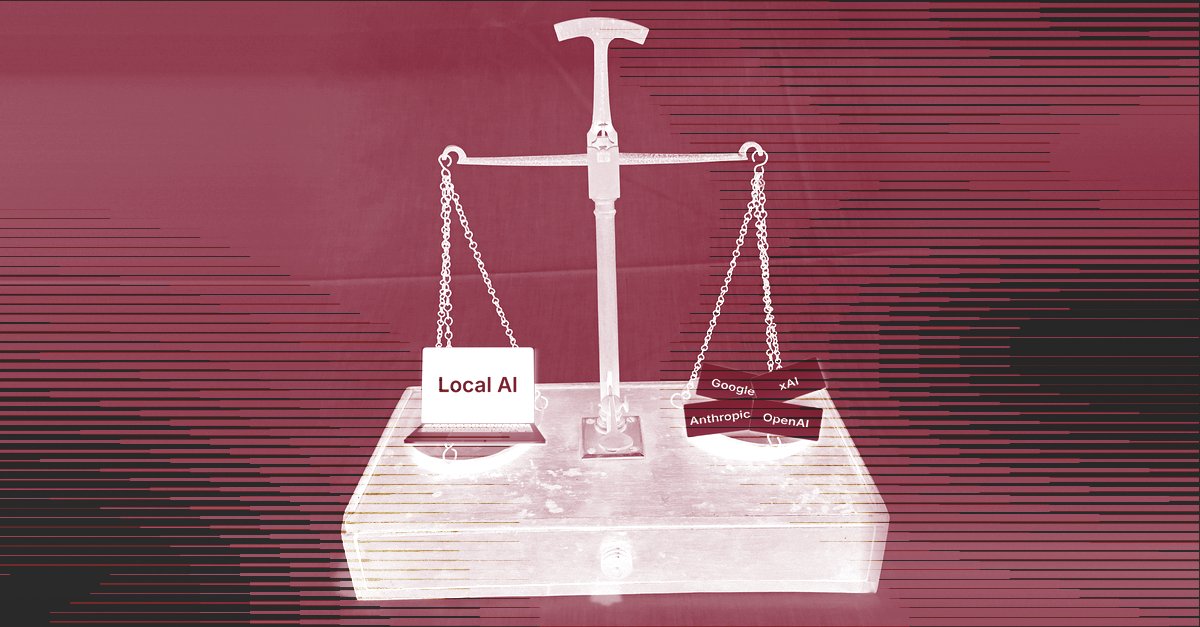
Frontier AI is the grid. Hosted models, metered by the token or billed by the month, run from data centres whose costs the labs pass on to their customers. Local AI is the rooftop panel. And just as a house with solar stays connected to the grid, a business running local models will still draw on hosted AI for the heavy lifting its own machines cannot manage. The hosted model becomes a service you call on when you need it, rather than the place all your work happens.
The local models are already good. Stanford researchers found that small models running on an ordinary computer could accurately handle about 88.7% of real-world chat and reasoning queries. In June, Nvidia announced a desktop AI platform for Windows PCs. Ollama, a free tool for running models locally, has more than nine million users. A well-specified laptop now runs a model about as capable as the frontier of a year or so ago, with no internet connection and no subscription.
The arithmetic follows, and it favours AI more than it favoured solar. Taking a home off-grid with panels and batteries can cost tens of thousands of dollars, which puts it out of reach for many households. A computer that runs a capable local model costs two or three thousand. What holds most businesses back today is that cost multiplied across everyone in the business, the effort of setting it up, and local models that cannot yet connect to everything the business uses. Each of those barriers is falling. As they do, a business paying several hundred dollars a month per person for hosted AI will find that owning beats renting for most of its work.
For lawyers there is a second reason to run a local model. A model running on your own machine sends client information nowhere. There is no offshore processing, no question about whether your prompts are training someone else’s model, and no exposure to a provider changing its terms. For a profession that owes duties of confidentiality, local AI removes a category of risk rather than managing it.
The labs can see it
Anthropic and OpenAI are preparing to list at valuations reported to exceed US$800 billion. Those valuations assume customers will keep paying a premium because they have no real alternative. Increasingly, they do.
Harvey, the legal AI company, has reportedly moved towards open-weight models after its gross margins fell from about 50% to minus 50% in six months. One investment chief put the exposure plainly: token deflation compresses the revenue line while compute commitments stay fixed.
The labs are now shifting to compete on distribution, memory and integration rather than raw intelligence. You make that move when you can see your lead on intelligence running out.
Not just yet…
You might say I am getting ahead of myself. For now, you would be right.
Memory shortages are pushing up the price of capable hardware, and PC shipments fell by about a fifth last quarter. Models small enough to run on a single consumer graphics card still trail the frontier by six to twelve months. Setting up a local model is harder than logging in to a website. For most businesses today (including mine), running everything on local computers does not make sense.
Rooftop solar did not make sense for most consumers in 2005 either. The direction of travel was clear well before the payback period crossed the line.
Plan for the tipping point
The question for a business is not whether to switch today. It is when local AI crosses the line, and whether you will be ready when it does.
That point arrives when a local model is good enough, and connected enough, to do everything your business already does with a hosted one. The connections are moving fastest. Open standards such as the Model Context Protocol, and ordinary APIs, already let a model running on your own machine reach your email, your documents, your practice management system and other third-party services. Once a local model can do the work and reach the tools, a hosted subscription is paying for capability most of your tasks will never use.
Plan for that point now. Keep your workflows portable rather than locked into one provider’s ecosystem. Favour tools built on open standards, so your integrations survive a change of model. Each time a subscription comes up for renewal, put the cost of owning your AI next to the cost of renting it.
The grid is not going anywhere. But few who bought panels at the right moment wish they hadn’t.
Yule Guttenbeil is a technology lawyer and ethicist and the Principal of Attune Legal.
